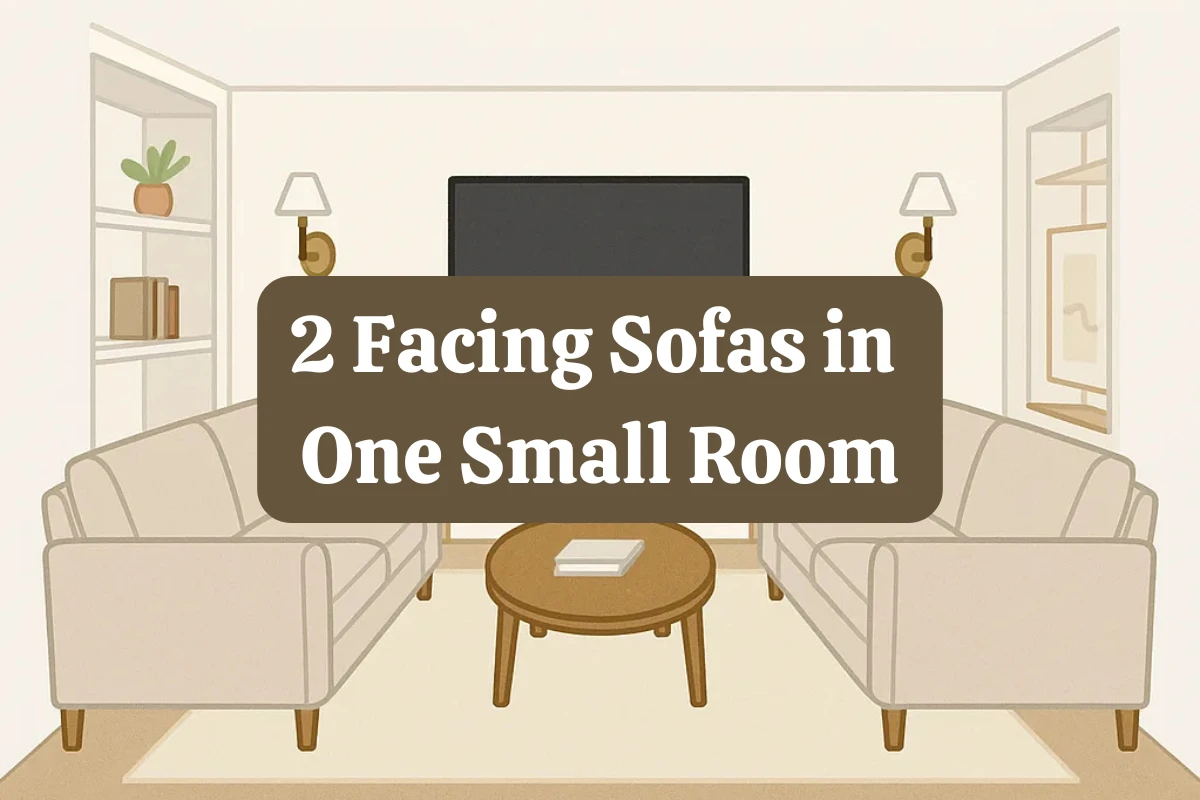
Fitting two sofas into a small living room might sound like a recipe for a cramped, furniture-jammed space. But with the right layout and a few smart styling choices, two facing sofas can anchor the space in a way that single sofas or sectional setups don’t always manage.
When two sofas face each other:
- You create a defined seating zone instead of one long lounging line.
- Eye-level sightlines stay open, especially if the sofas have low backs and exposed legs.
- The center of the room feels active, not empty.
- It’s ideal for entertaining and conversation—no more awkward neck craning across L-shapes.
Map the Real Footprint
Before dragging in two sofas and calling it done, it’s crucial to map out the real-life space they’ll occupy—and how people will move around them.
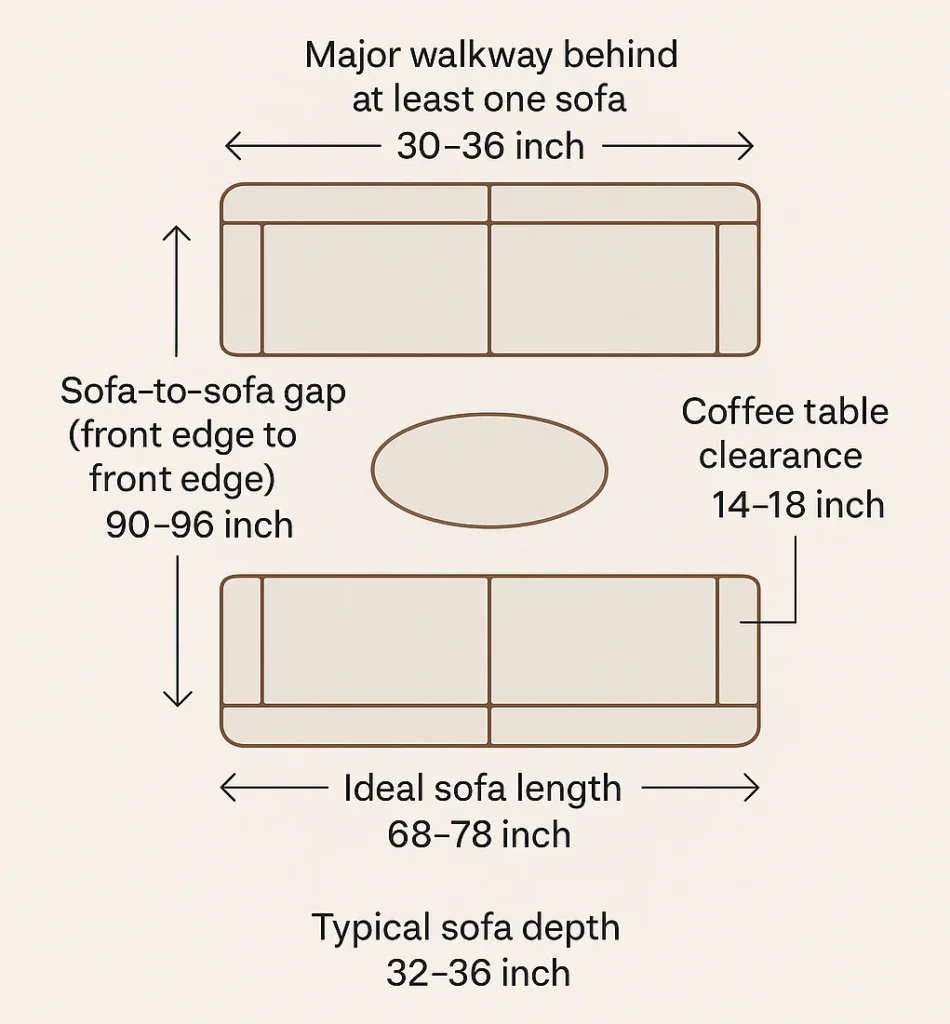
Below are the key dimensions that designers rely on to make a two-sofa setup feel cozy, not crowded.
| Rule of Thumb | Gold-Standard Measurement | Why It Matters |
|---|---|---|
| Major walkway behind at least one sofa | 30–36 inches of clear width | Keeps shoulders from brushing against pillows or arms as people pass behind. |
| Sofa-to-sofa gap (front edge to front edge) | 90–96 inches | Close enough for relaxed conversation, wide enough for a coffee table and room to stretch your legs. |
| Coffee table clearance | 14–18 inches from sofa to table | Makes it easy to reach your drink or remote—without shin-knocking when you stand up. |
| Ideal sofa length | 68–78 inches (max around 85″) | Fits comfortably in a typical 12 × 9 ft footprint without feeling wall-to-wall. |
| Typical sofa depth | 32–36 inches | Deep enough to lounge, but shallow enough to preserve breathing room between walls and traffic paths. |
Source: houzz.com, dimensions.com
How Much Space Do You Need?
Let’s say you’re using two sofas that are each 72 inches long, with the gold-standard 90-inch gap between their fronts. Add in an average 32-inch depth for each sofa and you’re looking at:
72″ + 90″ + 72″ = 234 inches (or 19.5 feet) of total front-to-front space required only if you line them up wall-to-wall.
But here’s the trick: float them just 4–6 inches off each wall, and suddenly your total footprint drops to around 8.5–9 feet of room depth. That’s a layout-friendly target for even modestly sized spaces.
Four Proven Layouts (Pick the One That Matches Your Room Shape)
Below are four field-tested layouts that create stylish, functional spaces in rooms of all sizes—each tailored to real-life dimensions and circulation needs.
1. Classic Face-Off
Best for rooms at least 11 × 13 ft
(Also a favorite in larger square or slightly rectangular living rooms)
Layout Overview
The Classic Face-Off is a timeless, balanced setup where two identical or similarly sized sofas face each other across a central coffee table. The arrangement centers around a single focal point—like a fireplace, TV, or bay window—and forms a cozy, enclosed seating area ideal for conversation or casual lounging.
This layout shines when your room can comfortably fit:
- Two standard sofas (68–75″)
- A coffee table (usually 42–48″)
- Clear walkways for movement
Unlike sectionals, this setup doesn’t rely on anchoring to a long wall, making it equally at home in square or rectangular rooms—especially when grounded by a well-sized rug.
Furniture Placement Tips
- Sofas: Face the sofas directly toward each other, floating them 4–6 inches off the walls for breathing room.
- Coffee Table: Use a rectangular or oval table placed 14–18 inches from each sofa for leg comfort and easy access.
- Focal Point Wall: Center your TV, fireplace, or window between the sofas and frame it with artwork or sconces for symmetry.
- Walkway: Leave 30–36 inches of clearance behind the sofa closest to the main entry for proper traffic flow.
Real Room Dimensions Breakdown
- Sofa length: 72″
- Sofa depth: 32″ each
- Coffee table: 48″
- Spacing (sofa to table): 16″ each side
Total depth needed: 32 + 16 + 48 + 16 + 32 = 144″ (12 ft)
Add 12″ walkway buffer = 13 ft total room length
Width = 72″ sofa + some side clearance = 11 ft minimum
✅ This layout fits comfortably in 11 × 13 ft rooms, as verified by standard furniture planning guides (Dimensions.com).
✨ Bonus Styling Advice
- Use a rug: An 8 × 10 ft rug anchors the layout and visually connects all elements.
- Go light and low: Choose sofas with exposed legs and backs under 32″ to avoid blocking sightlines or windows.
- Keep it airy: Slim side tables or arc lamps avoid bulk while enhancing symmetry.
2. Offset Aisle
Best for long, narrow rooms (around 8 × 14 ft or larger)
(Also great for open layouts with one-direction traffic flow)
Layout Overview
The Offset Aisle layout is designed for spaces where width is tight, but length is generous. Instead of centering the seating area, you shift the sofas 12–18 inches toward one long wall, freeing up a 36-inch built-in aisle on the opposite side.
You still get the intimacy of a face-to-face setup—but now there’s a natural traffic path to nearby doors, dining areas, or adjacent rooms.
This layout is ideal when:
- The doorway sits on the side wall
- You regularly pass through the space
- Centering the seating causes congestion
Furniture Placement Tips
- Sofas: Offset the whole setup slightly to one side. The asymmetry creates balance between seating and circulation.
- Coffee Table: Stick to 14–18 inches of sofa clearance on both sides to preserve legroom.
- Traffic Aisle: Maintain a full 36-inch path for easy movement around, not through, the furniture.
- Lighting: Use sconces or slender floor lamps along the offset wall to light the path without crowding the zone.
Real Room Dimensions Breakdown
- Sofa length: 72″
- Sofa depth: 32″
- Coffee table: 48″
- Offset: 12–18″ additional clearance on one side
Total width: 32 + 16 + 48 + 16 + 32 = 144″ + 18″ offset = ≈ 13.5 ft
Total length (sofa + clearance): 72 + 36 = 9 ft minimum
✅ Works well in rooms 8 × 14 ft and up, offering comfort without blocking access.
✨ Bonus Styling Advice
- Let the rug guide it: An 8 × 10 rug still fits—just align it to the sofas, not the room center.
- Balance asymmetry: Add a console, shelves, or artwork to the more “open” wall for visual weight.
- Widen the feel: Hang a mirror on the open aisle wall to bounce light and enhance depth.
- Choose light furniture: Raised legs and low backs keep the layout visually open.
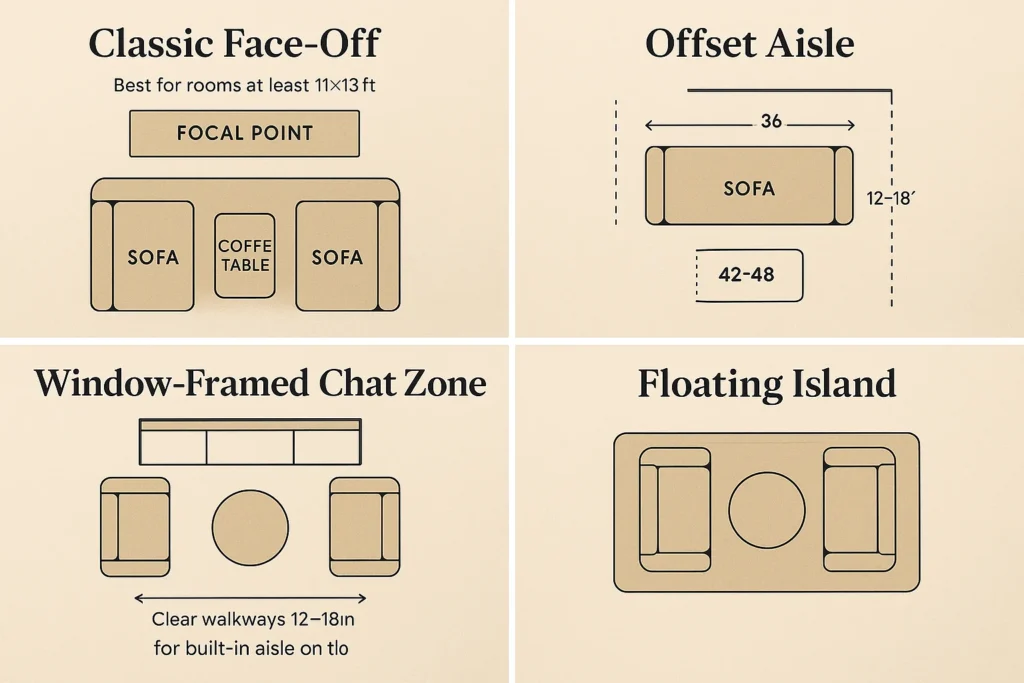
3. Window-Framed Chat Zone
Best for living rooms with a picture window, shallow bay, or sliding doors
(Also great for medium-sized rooms with strong daylight features)
Layout Overview
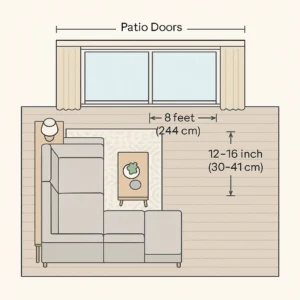
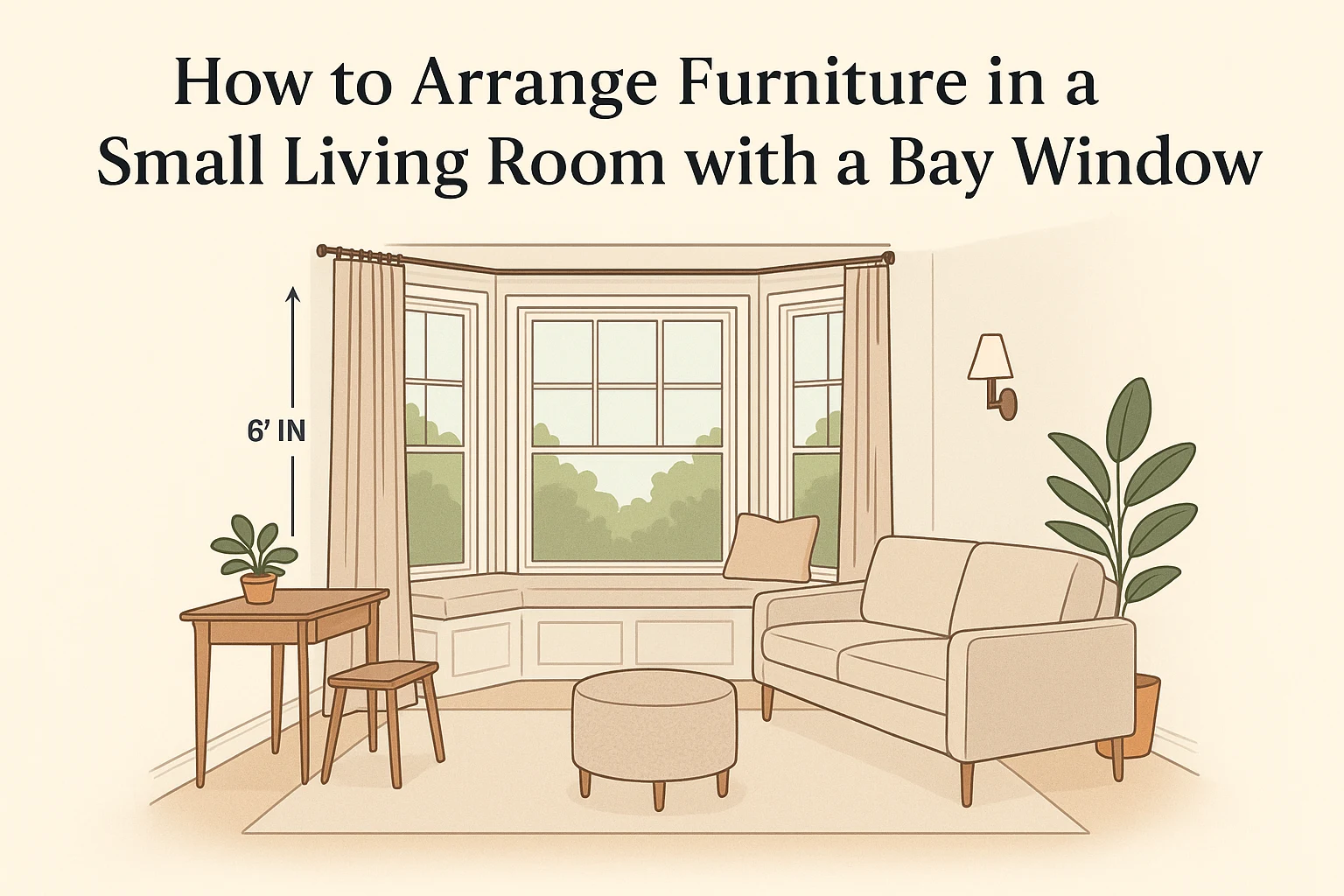
This layout embraces natural light as your strongest design ally. With two sofas facing each other and a window or bay alcove centered behind one of them, you frame the daylight instead of blocking it. The open middle allows light to spill directly down the center aisle.
Use this setup if your room features:
- A picture window or shallow bay (under 24″ deep)
- A sliding glass door
- A short wall with scenic views or bright light
Rather than pushing furniture against the glass, you’re creating a visual stage around it.
Furniture Placement Tips
- Sofas: Position sofas perpendicular to the window wall, 6–12 inches in from the returns to frame the view.
- Coffee Table: Use a round or low-profile piece to avoid interrupting the sightline to the window.
- Window Treatments: Try ceiling-mounted curtains or Roman shades for a clean, high-frame effect.
- Lighting: Place table lamps or wall sconces at sofa ends—not in front of the window—to preserve natural light flow.
Real Room Dimensions Breakdown
- Sofa length: 68–75″
- Sofa depth: 32″
- Coffee table: 36–40″ round
- End walkways: 30–36″
Total width: ≈ 11.5–12 ft
Total length (along window wall): 75″ + 60″ total clearance = ≈ 11–12 ft
✅ Ideal for rooms 11 × 12 ft and up, especially if you want the window to shine.
✨ Bonus Styling Advice
- Mirror the view: Add art or a mirror opposite the window to double the visual impact.
- Don’t block the glass: Skip tall backs or shelving—use poufs, plants, or a bench instead.
- Go round: A circular rug or ottoman complements the open, symmetrical feel.
- Adjust for off-center windows: Balance the room with a tall plant or shelf if the window isn’t perfectly placed.
4. Floating Island
Best for open-concept layouts, studios, or flexible combo spaces
(Especially effective in rooms 12 × 14 ft and up with flow on all sides)
Layout Overview
The Floating Island is the most flexible—and the most modern—of all. Instead of anchoring to walls, two sofas face each other completely floated on a large rug, forming a room-within-a-room.
This layout is perfect for:
- Studios need a division between sleep and lounge zones
- Open living/dining rooms
- Great rooms with multiple focal points (TV, view, fireplace)
By “floating” everything mid-room, you create structure without walls—and circulation paths on all sides.
Furniture Placement Tips
- Rug: Use an 8 × 10 or 9 × 12 rug to define the zone. Let it extend 6–12 inches beyond the sofa footprints.
- Sofas: Choose leggy, low-back styles for openness. Keep 14–18 inches between seat fronts and the coffee table.
- Coffee Table: Round or soft-edge rectangular tables prevent sharp corner collisions.
- Surrounding Circulation: Leave 30–36 inches of space around the entire rug area.
- TV or Console: Use a wall-mounted TV on the far side, or float a console behind one sofa.
Real Room Dimensions Breakdown
- Sofa depth: 32″
- Coffee table: 48″
- Clearance around: 36″ minimum
Total width footprint: 32 + 16 + 48 + 16 + 32 = 144″ + 72″ clearance = 18 ft
Length: 72″ + 72″ buffer = 12 ft
✅ Best for 12 × 14 ft rooms and larger, especially in open or undefined spaces.
✨ Bonus Styling Advice
- Color block it: Use rug and cushion tones to clearly define your island zone.
- Console it: A slim console behind one sofa adds function and separation.
- Light from above: A pendant or flush-mount light over the rug centers the space visually.
- Avoid bulk: Skip tall chairs and bookshelves to keep the layout breezy.
In conclusion, fitting two sofas in a small living room isn’t about stuffing more furniture in—it’s about shaping a functional, welcoming zone that encourages conversation and connection.