




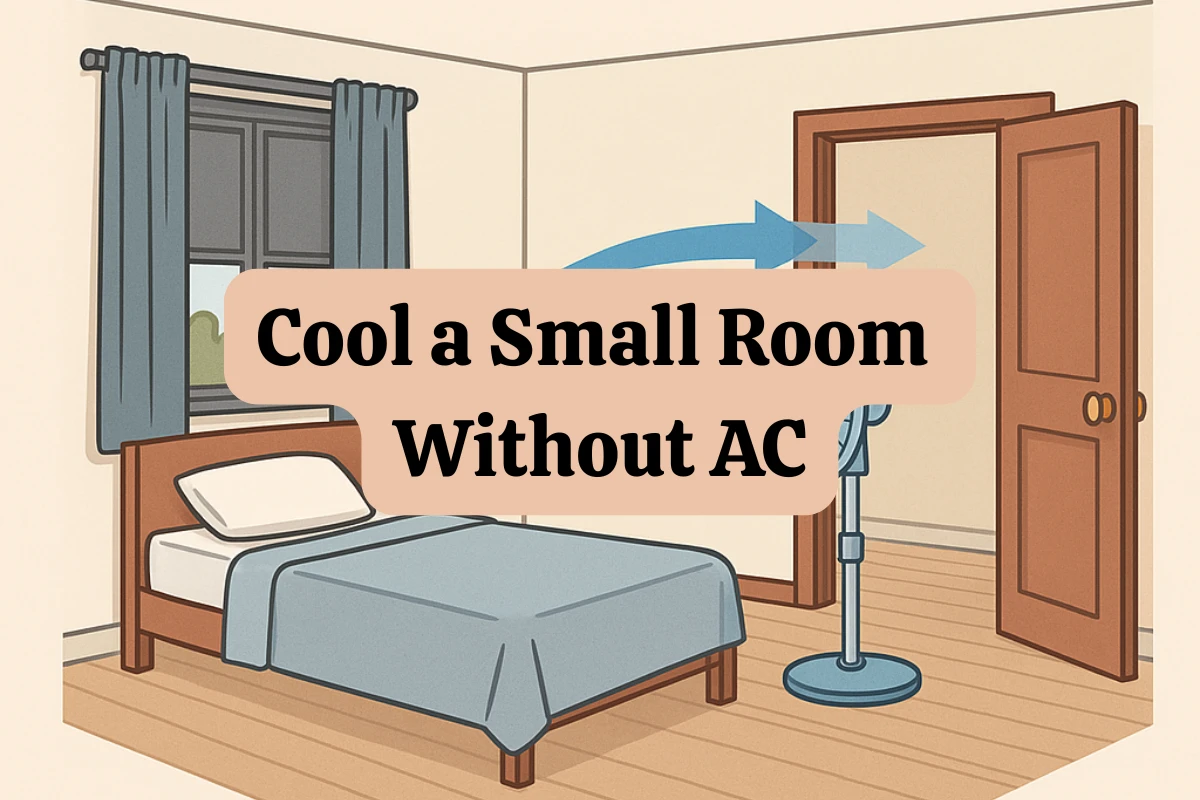
When the temperature rises and air conditioning isn’t an option—maybe because of cost, noise, or lease restrictions—it’s time to shift your goal from refrigeration to heat management.
- 1. Block the Sun Before It Turns Into Indoor Heat
- ▸ Close Curtains—But Make Them Count
- ▸ Reflect Sunlight with Window Film or Exterior Shades
- ▸ Seal Cracks to Keep Hot Air Out
- ▸ Use Smart Blinds or Timers
- 2. Turn One Small Room Into a Cross-Ventilation Machine
- 3. Use Fans Intelligently (and Cheaply)
- ▸ Ceiling Fans: Set Them for Summer
- ▸ Spot Fans + Ice = DIY Chill
- ▸ Try a DIY Evaporative Cooler (Dry Climates Only)
- 4. Lower Humidity to Feel Cooler
- 5. Eliminate Internal Heat Sources
- 6. Insulate Now, Sweat Less Later
- ✅ Rapid-Fire Checklist
This guide walks you through proven, science-backed strategies that use airflow, insulation, and everyday items to cool your space. No AC unit? No problem. These methods are renter-friendly, affordable, and easy to roll out today.
1. Block the Sun Before It Turns Into Indoor Heat
Sunlight might be beautiful, but in a small room, it’s your biggest heat source. Once sunlight enters through windows, it gets trapped as heat—especially when it hits dark floors, bedding, or furniture.
The solution? Block it before it gets in.
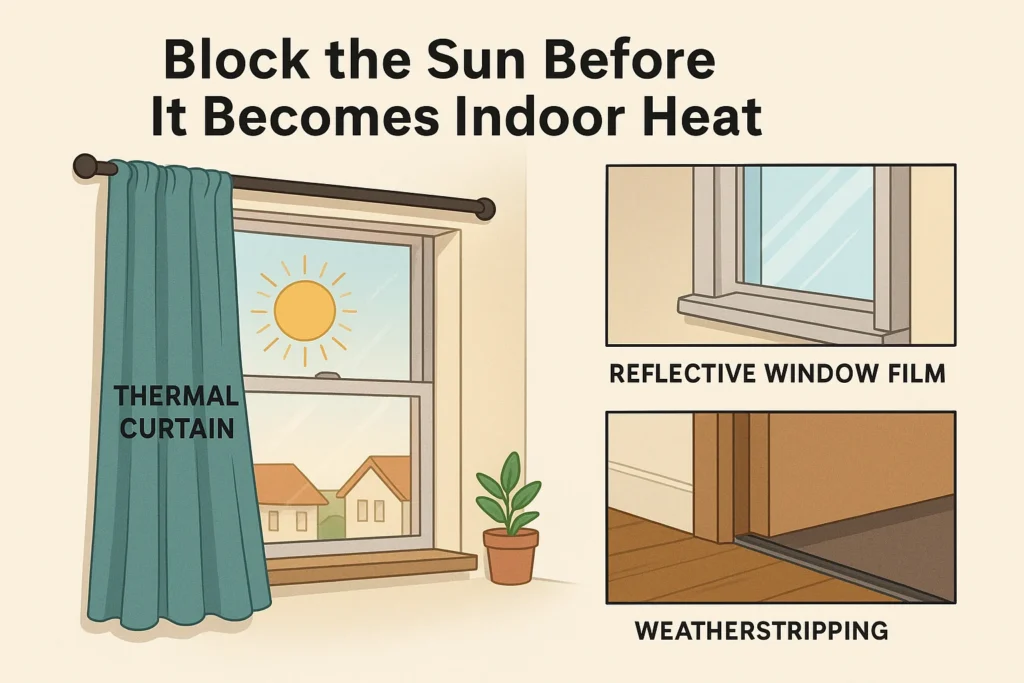
▸ Close Curtains—But Make Them Count
Ordinary curtains help, but thermal or insulated curtains work much better. Choose medium-tone fabrics backed with white plastic liners. According to the U.S. Department of Energy, these can cut heat gain by up to 33% on sun-facing windows.
- Hang them close to the window, all the way to the floor or sill
- Keep them closed from 10 a.m. to 4 p.m., when sun exposure peaks
- Use magnetic strips or Velcro on the edges to reduce heat leaks around the sides
▸ Reflect Sunlight with Window Film or Exterior Shades
Reflective window films bounce sunlight back outside before it turns into heat. They’re affordable, renter-friendly, and easy to install.
Even better? Exterior shades like awnings, solar screens, or shutters. These stop heat before it touches the glass. DOE data shows that exterior shading can block up to 80% of solar heat on south-facing windows.
▸ Seal Cracks to Keep Hot Air Out
Blocking sunlight is step one. Step two? Stop warm outdoor air from creeping in.
- Add stick-on weatherstripping around window frames and door edges
- Install door sweeps at the bottom of doors
- These quick fixes prevent the “chimney effect,” where rising warm air pulls more hot air in through gaps
▸ Use Smart Blinds or Timers
Not home during the day? Set up smart blinds to close by mid-morning and reopen in the late afternoon. No smart home setup? A basic outlet timer works with many motorized shades.
2. Turn One Small Room Into a Cross-Ventilation Machine
Can’t cool the air? Move it. Cross-ventilation helps push out stale, hot air and pull in cooler outdoor air. It’s a powerful way to cool your room without changing the thermostat.
▸ How Cross-Ventilation Works
Air naturally moves from high pressure to low pressure. If you create an opening on one side of the room (intake) and a larger one on the other (exhaust), you can create a flow that moves air straight through.
According to the Whole Building Design Guide, even small openings can create up to 10 air changes per hour—depending on wind direction and pressure.
▸ How to Set It Up in a Single Room
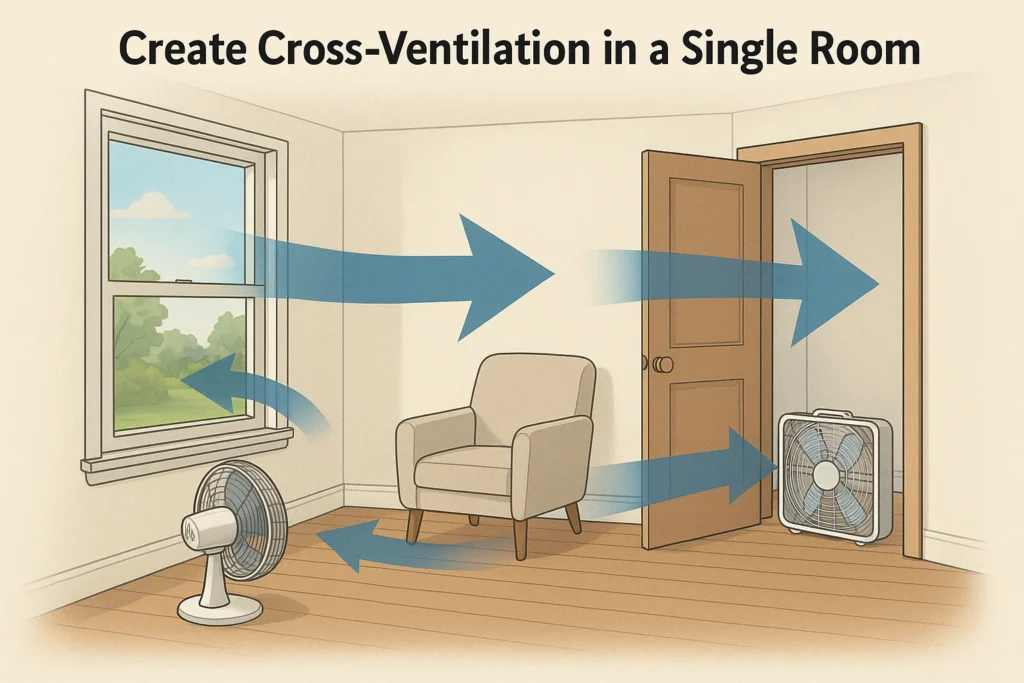
Even with just one window, you can rig a mini cross-breeze:
- Open the window a few inches. If there’s wind, this becomes your intake. Place a fan in front, angled inward.
- Open the door on the opposite side of the room. Put a box fan at the bottom blowing outward. This is your exhaust.
- Optional: If you have a second fan, position it diagonally between the window and door to move air across your bed or workspace.
This setup pulls cooler air in and pushes warm air out—especially effective in the early morning or evening when outside temps are lower.
▸ Pro Tip: Use It at Night
If it’s safe to do so, leave the window cracked wider at night and run the fans while you sleep. The cooler air helps lower your body temp, remove stuffiness, and improve sleep quality.
3. Use Fans Intelligently (and Cheaply)
Fans don’t lower a room’s temperature, but they can make you feel much cooler. With the right strategy, fans can mimic wind chill, push hot air out, and even bring down humidity.
▸ Ceiling Fans: Set Them for Summer
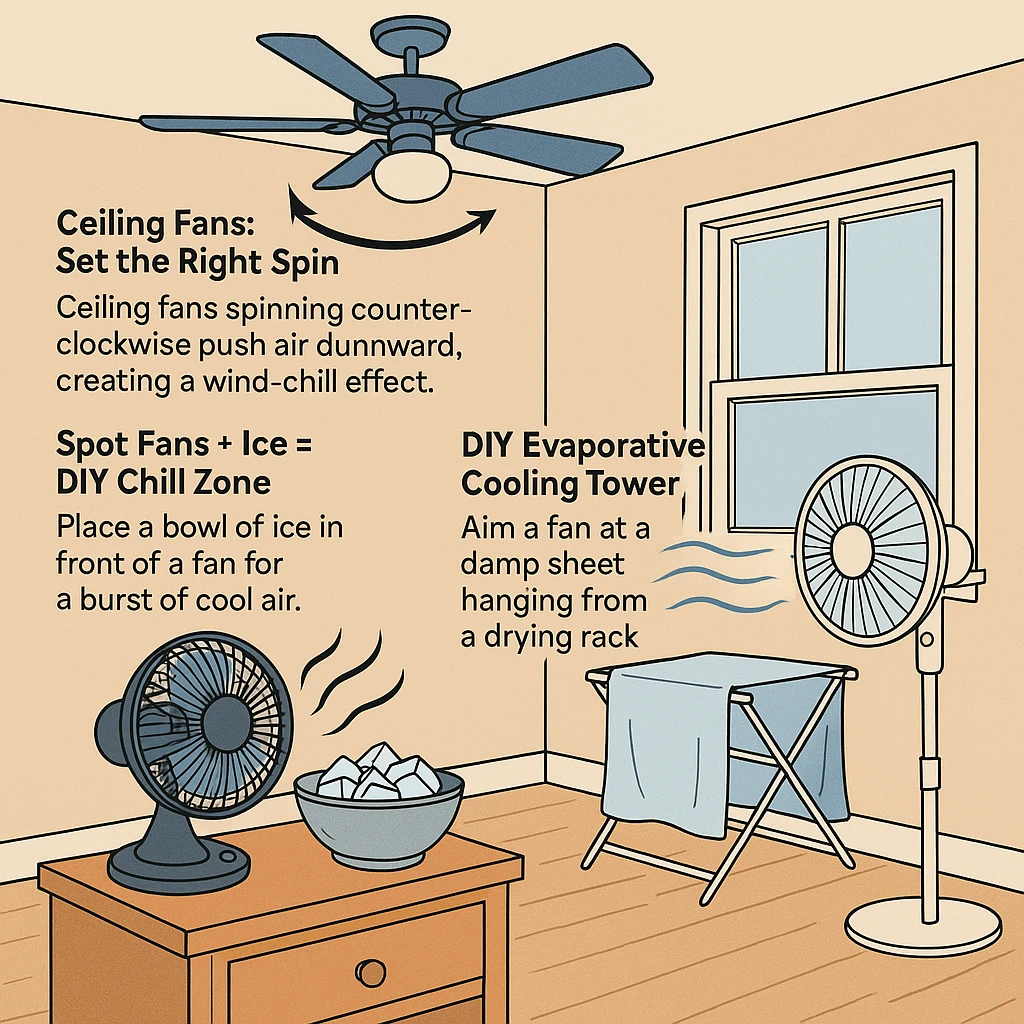
If you have a ceiling fan, make sure it’s spinning counterclockwise during summer. This pushes air down, helping sweat evaporate and making you feel 4–6°F cooler.
Not sure it’s correct? Stand under the fan. If you feel a strong breeze, it’s good to go. If not, flip the switch on the fan’s base.
▸ Spot Fans + Ice = DIY Chill
Try the old-school trick: place a bowl of ice or frozen water bottles in front of a fan. As the fan blows air across the ice, it cools and spreads throughout the room.
- Use a metal bowl for better chill
- Place it near your desk, bed, or chair
- Swap ice regularly and use a tray for condensation
Reddit users swear by this hack—especially in stuffy bedrooms during heatwaves.
▸ Try a DIY Evaporative Cooler (Dry Climates Only)
If your climate is dry (under 60% humidity), make a quick evaporative cooler:
- Drape a wet cotton sheet over a clothes rack or chair
- Point a fan through the damp fabric
This cools the air as it passes through—just like a swamp cooler. It’s great for overnight comfort in arid zones.
⚠️ Not for humid climates—the air’s already too saturated to evaporate more moisture.
4. Lower Humidity to Feel Cooler
Humidity makes heat feel worse. It slows sweat evaporation, making you feel sticky and hot. Lowering moisture can help you feel several degrees cooler, even without dropping the temperature.
▸ Use a Small Dehumidifier
Compact models (for <250 sq ft) are energy-efficient and can drop humidity 10–20%—which can reduce perceived temp by 2–4°F.
▸ Try Passive Moisture Absorbers
Silica gel, DampRid, and other desiccants are great for closets, under-bed areas, or stuffy corners. No electricity needed.
▸ Vent Moisture at the Source
- Run exhaust fans during cooking or showering
- Keep bathroom and kitchen doors closed during steam-heavy tasks
- Avoid indoor clothes drying when possible
5. Eliminate Internal Heat Sources
If your room already feels like an oven, the last thing you want is to add more heat from the inside. Yet many everyday items do just that—quietly radiating warmth and tipping the temperature even higher.
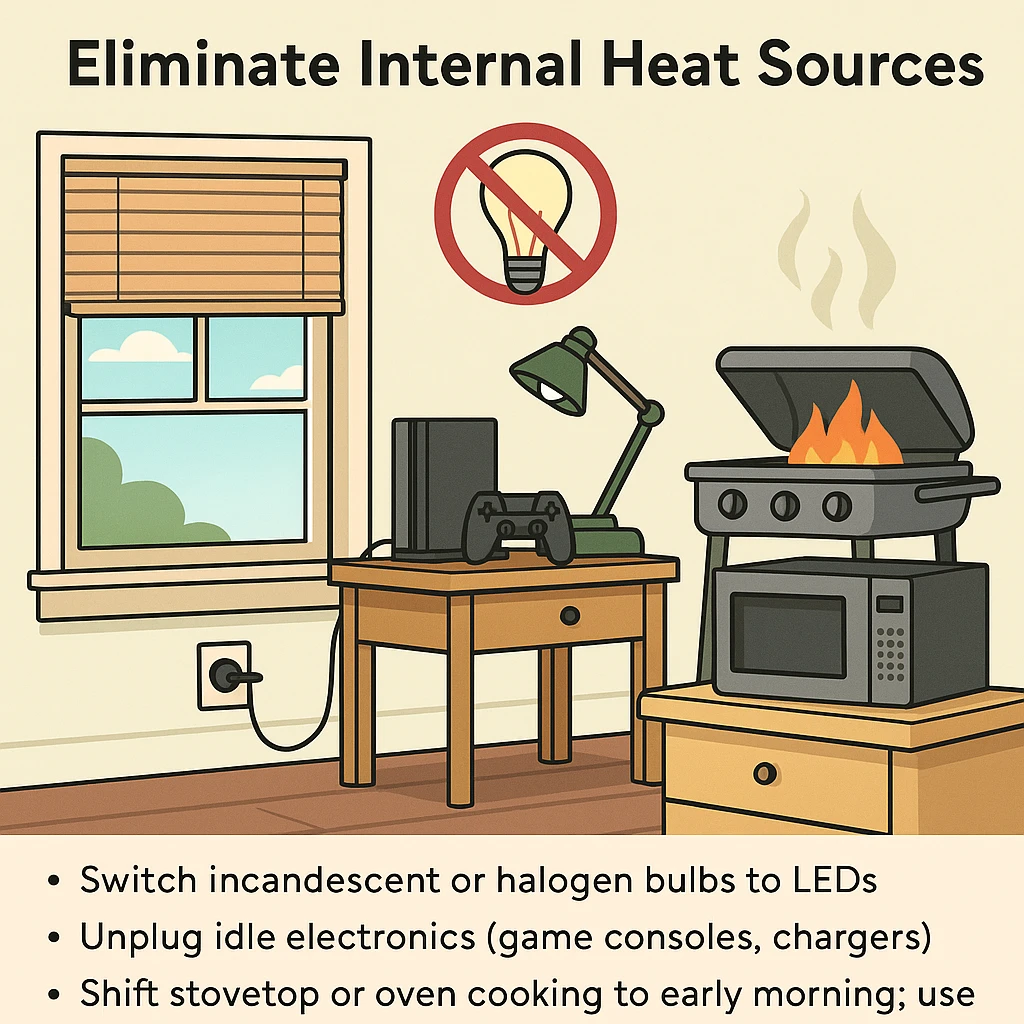
Reducing these internal heat sources can make a surprisingly big difference, especially in small rooms where every degree counts.
- Switch to Cooler Lighting: Incandescent and halogen bulbs convert most of their energy into heat. Swap them for LEDs, which stay cool and use far less power (WIRED).
- Unplug Phantom Power Loads: Electronics like chargers, consoles, and printers emit heat even in standby mode. Unplug them when idle or use a power strip with a shutoff switch.
- Cook Smarter, Not Hotter: Avoid using the oven or stove during peak heat hours. Cook in the early morning, use a microwave or slow cooker, or take it outdoors with a grill.
Removing hidden heat sources doesn’t just cool your room—it also makes your fan or ventilation setup work more effectively.
6. Insulate Now, Sweat Less Later
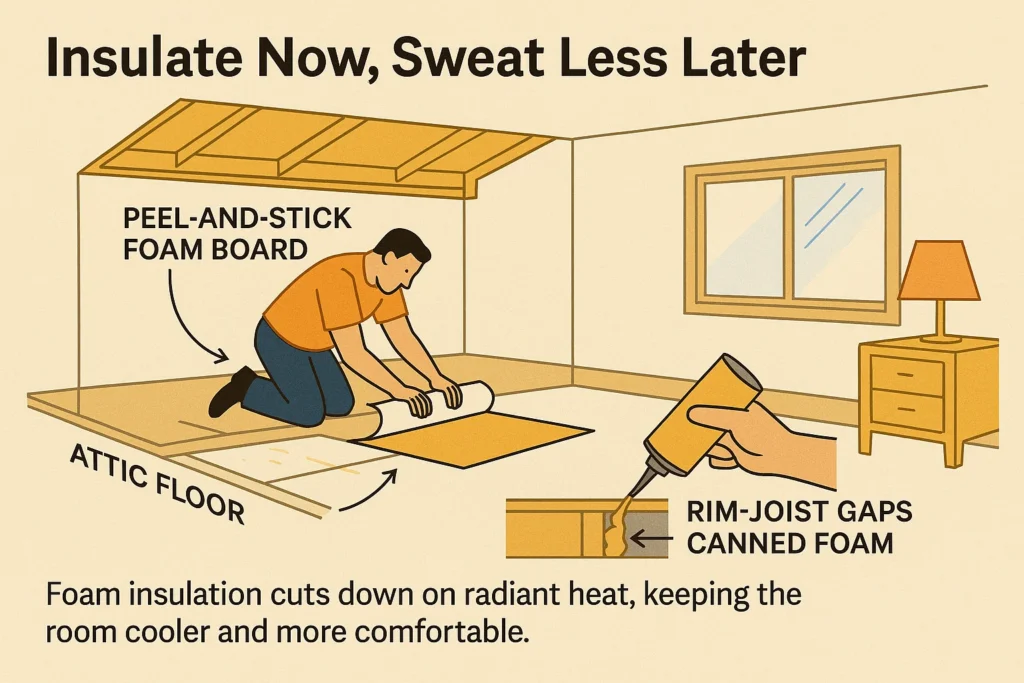
Insulation isn’t just for winter. It also helps keep heat out in summer—especially in rooms that sit under an attic or near sun-exposed walls.
▸ Stop Heat at the Source
Hot air loves to sneak in through attics, crawl spaces, and wall gaps. A few small upgrades can block that transfer:
- Add insulation to the attic floor if your room is directly below it. Even peel-and-stick foam board or blown-in cellulose can cut radiant heat dramatically.
- Seal rim joists (where floor meets foundation) with low-expansion spray foam. These are often leaky heat highways, especially in older homes.
- Use caulk and weatherstripping to seal cracks around windows, doors, and baseboards.
▸ Reflect It Away
In hot climates, radiant barriers bounce sunlight before it gets inside:
- Staple foil-faced barriers to the underside of roof rafters
- Or roll them over attic insulation
- Consider a reflective roof coating to deflect even more solar heat
According to the U.S. Department of Energy, combining insulation and shading can keep homes cool and comfortable most of the year without air conditioning—especially in dry or mild climates.
✅ Rapid-Fire Checklist
- Close sun-facing curtains by 10 a.m.
- Crack a window high and exhaust with a door fan for cross-breeze.
- Aim a fan at frozen water bottles for quick DIY cooling.
- Run a dehumidifier until humidity drops below 50%.
- Cook outside, swap in LEDs, and unplug idle electronics.
- Stay hydrated and sleep in light, breathable fabrics.
Master these simple moves, and you’ll chip away at every source of heat—proving you don’t need a noisy AC unit to reclaim a cool, comfortable space.