




A sectional can be a small-space superhero—if you give it a floor plan that respects traffic flow, daylight, and scale.
Below are five proven sectional layouts that work even in compact rooms, as small as 10 × 10 feet, complete with diagrams and design tips.
Contents
The Corner-Hugging Anchor
Best for: Square or slightly rectangular rooms (as small as 10′ × 10′)
Sectional Type: L-Shaped
Ideal for: Creating maximum seating with minimal footprint
The Corner-Hugging layout is the most space-efficient way to fit a sectional into a small room. By tucking an L-shaped sectional into the corner where two walls meet, you instantly put that forgotten “dead space” to good use—and in the process, you open up the center of the room.
It also helps your layout fall into place naturally: once the sectional is placed, your focal point (like a TV, fireplace, or artwork) naturally finds its home on the opposite wall. With the center clear and the corners working harder, your space feels larger, more open, and easier to navigate.
Placement & Measurement Tips
| Element | Recommended Guidelines |
|---|---|
| Sectional Dimensions | Choose a compact L-shape: 78–90″ wide on the long side and 58–70″ on the short return. Avoid bulky arms and backs. |
| Walkways | Keep 30–36 inches clear at the open end for easy entry and circulation. |
| TV or Focal Wall Distance | Allow 7–8 feet between the sectional and screen—ideal for a 55″ TV. |
How to Style It Well
- Use an airy rug: A 5’×7′ or 6’×9′ rug grounds the area without crowding it.
- Choose low, raised designs: Sectionals with legs (4–6″) and back heights under 32″ keep sightlines open.
- Add height in corners: Floor lamps, tall plants, or mirrors help pull the eye upward and visually expand the room.
- Limit bulky end tables: Stick to round, slim styles—14–18″ wide—to keep traffic flow smooth.
🏡 Real-Life Example
Room size: 10′ × 10′
Sectional: Compact L-shaped, 84″ × 62″, raised-leg style
Setup: The sectional tucks into the back-right corner. A 5′ round rug centers the space, with a wall-mounted TV across from the long side. A tall arc lamp lights the corner, and a floating shelf above adds storage without bulk.
Result: Open, balanced, and deceptively spacious.
The Floating Room Divider
Best for: Open-concept layouts, studios, or long narrow spaces
Sectional Type: Chaise or Reversible L-Shaped
Ideal for: Dividing zones without building walls
The Floating Room Divider layout places your sectional away from the walls—typically in the center of the room—to split a larger space into clearly defined zones. The back of the sofa acts as a soft divider, subtly separating the living area from adjacent spaces like the dining zone, kitchen, entryway, or workspace.
This setup is perfect for open floor plans or studios where you want visual structure without adding barriers. With walkways on both sides, the space feels balanced and breezy. Add a rug or console table, and the look becomes polished and purposeful.
Placement & Measurement Tips
| Element | Recommended Guidelines |
|---|---|
| Sectional Dimensions | Chaise-style or reversible L-shaped, 84–92″ long with a 60–65″ chaise. |
| Spacing from Wall | Float 3–5 inches off the wall—or more if placing a console or shelf behind. |
| Walkways | Leave 30–36 inches of circulation space on both sides. |
| Zone Depth | Allocate at least 6–8 feet for the full living zone (including rug and coffee table). |
How to Style It Well
- Anchor with a rug: A 6′ × 9′ rug helps visually ground the seating zone.
- Place a console behind: A narrow table behind the sofa adds storage, lighting, or display space.
- Layer your lighting: Combine overhead fixtures, sconces, and floor lamps for depth and zoning.
- Keep décor symmetrical: Since the back of the sectional is visible, go for a clean, balanced look.
🏡 Real-Life Example
Room size: 12′ × 18′ open-concept living/dining
Sectional: 88″ long with 62″ chaise
Setup: The sectional floats mid-room to divide the living area from the dining space. A 6′ × 9′ rug anchors the seating. A slim 12″ console behind the sofa holds lighting and books, while wall shelving defines the dining zone.
Result: A functional, visually zoned space that feels cohesive and open.
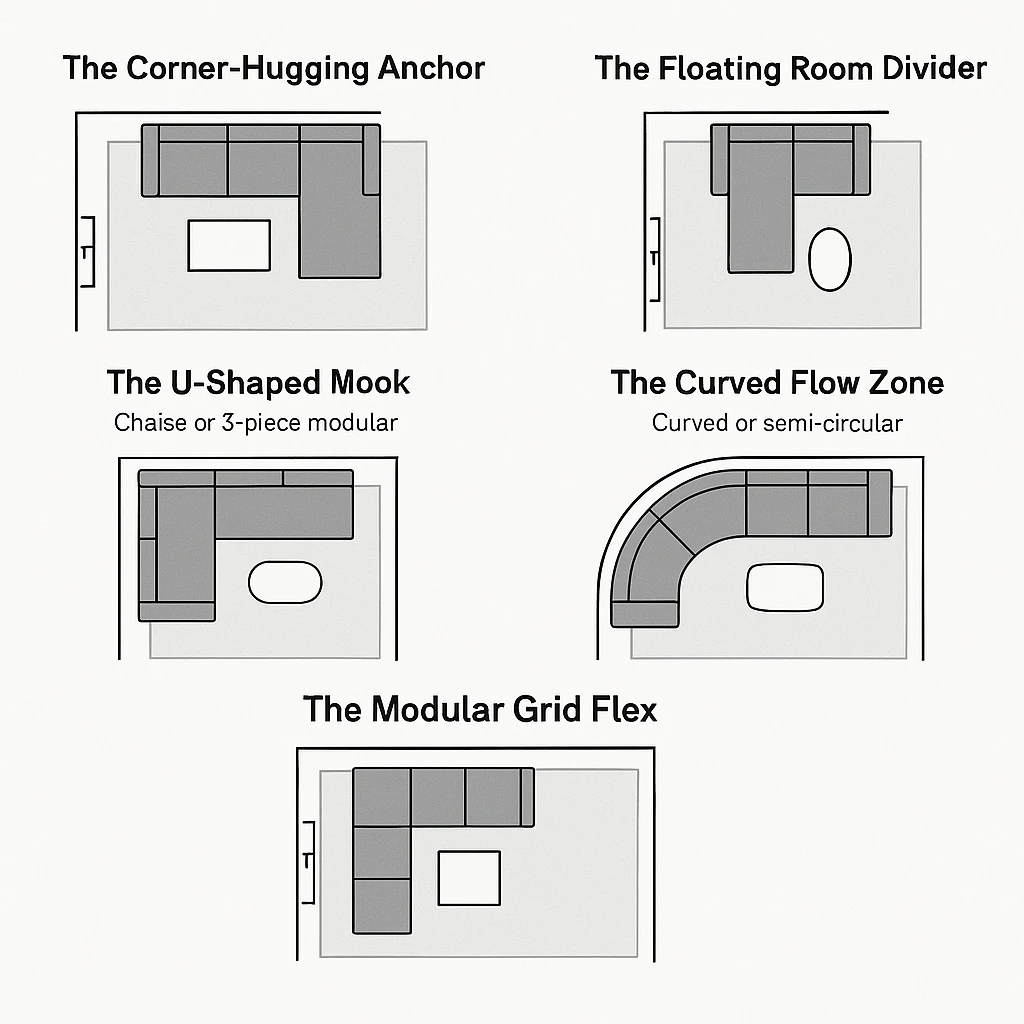
The U-Shaped Nook
Best for: Long, narrow rooms or open layouts that need cozy definition
Sectional Type: U-shaped or modular
Ideal for: Creating a tucked-in, conversation-ready seating area
The U-Shaped Nook layout wraps the seating area on three sides, creating a cozy, enclosed zone that feels like a room within a room. It’s a smart choice for long, narrow spaces where a single sofa might feel lost, or for open layouts where you want to carve out a distinct living area.
Instead of focusing all seating toward a single wall, this layout invites conversation and face-to-face lounging, making it perfect for families, entertaining, or movie nights. It also keeps the perimeter clear, which helps maintain balance in asymmetrical or multi-use rooms. When done right, it feels both intimate and open.
Placement & Measurement Tips
| Element | Recommended Guidelines |
|---|---|
| Sectional Dimensions | Arms 30–36″ deep; total U width within 10–12 feet. |
| Walkways | Maintain 30–36 inches between sofa arms and nearby walls/furniture. |
| Coffee Table Spacing | Leave 18 inches between seating and table or ottoman. |
| Focal Point | Use a swivel-mounted TV or art piece viewable from multiple angles. |
How to Style It Well
- Choose a round or oval coffee table: It mirrors the shape and eases circulation inside the U.
- Use a large rug to tie all sides together: A 6′ × 9′ or larger rug helps ground the layout.
- Go for low-back, raised-leg designs: Keeps the look light and avoids crowding.
- Limit wall décor: Let one focal point (like a mirror or art piece) shine, and keep other walls simple.
🏡 Real-Life Example
Room size: 11′ × 15′
Sectional: Modular U-shape, 36″ deep arms, 120″ total width
Setup: The U-shape frames a 36″ round ottoman. A 6′ × 9′ rug centers the space. A wall-mounted TV and single floor lamp complete the setup without visual bulk.
Result: A cozy, symmetrical zone that feels private yet open.
4. The Curved Flow Zone
Best for: Irregular-shaped rooms, open plans, or areas with natural flow paths
Sectional Type: Curved or semi-circular
Ideal for: Softening angles and guiding movement through the space
The Curved Flow Zone layout uses a rounded or semi-circular sectional to create a soft, organic seating area that feels inviting and architectural. Instead of drawing harsh lines or anchoring the sofa in a corner, this layout lets the sectional float more freely, shaping the room with gentle curves that are easy to navigate around.
It’s perfect for open-concept rooms or spaces with unusual architecture, where you don’t want a traditional L- or U-shape cutting the room in half. Curved sectionals help maintain natural circulation paths, make rooms feel more fluid, and promote easy conversation since everyone faces slightly inward.
Placement & Measurement Tips
| Element | Recommended Guidelines |
|---|---|
| Sectional Dimensions | 7–9 feet wide across the arc; keep seating depth under 36″. |
| Walkways | Leave 30–36 inches around the curve’s open sides. |
| Table Shape | Use a round or oval table, 36–42″ wide, to mirror the sectional’s curve. |
| Room Shape | Ideal in rooms with no defined corners or angled layouts. |
How to Style It Well
- Pair with a round rug: A 6′ or 8′ round rug keeps the design cohesive and soft.
- Limit accessories along the curve: One slim side table or floating shelf is often enough.
- Add height with plants or arched mirrors: They echo the curve and help balance the visual flow.
- Use diffused lighting: Floor lamps or sconces with soft shades match the layout’s relaxed style.
🏡 Real-Life Example
Room size: 13′ × 17′ open plan
Sectional: Semi-circular, 8′ wide end-to-end
Setup: The curved sofa surrounds a 42″ round coffee table. A round jute rug and two arched floor lamps echo the shape.
Result: A graceful, social layout that blends effortlessly into the larger space.
The Modular Grid Flex
Best for: Multi-use spaces, evolving layouts, or renters who love flexibility
Sectional Type: Modular or armless block-style
Ideal for: Rearranging on demand and maximizing versatility
The Modular Grid Flex layout uses square, movable seating units that can be configured into an L-shape, U-shape, long bench, or broken apart for extra seating. It’s ideal for people who like to rearrange frequently or for rooms that need to multitask—like a living room that’s also a guest room or workspace.
With no fixed backs or arms, this layout feels light, open, and endlessly adaptable.
Placement & Measurement Tips
| Element | Recommended Guidelines |
|---|---|
| Unit Size | Each piece is typically 30–36″ square; use 3–5 units depending on space. |
| Walkways | Maintain at least 30 inches of space around or between modules. |
| Configuration | Start with a 2×2 or 2×3 grid, then arrange into an L, U, or chaise layout. |
| Room Flexibility | Ideal for shared spaces, rentals, or homes with guests. |
How to Style It Well
- Use a grounding rug: A 6′ × 9′ rug helps define your current setup and keeps modules from drifting.
- Skip the arms: Armless designs make it easier to rearrange and keep sightlines open.
- Pair with modular tables and ottomans: Nesting tables and lightweight furniture support the flexible vibe.
- Keep accessories handy: Extra pillows, poufs, and throw blankets make it easy to adapt your setup on the fly.
🏡 Real-Life Example
Room size: 10′ × 13′
Sectional: Five modular units, each 32″ square
Setup: Four pieces form an L, and the fifth acts as a floating ottoman. A 6′ × 9′ rug defines the space, with a set of nesting tables and a slim bookshelf doubling as a room divider.
Result: A fully flexible layout that can shift for movie nights, guests, or work-from-home needs, without a single heavy lift.
Think about how you move through the room, where the light comes in, and what you want the space to feel like. With a bit of planning, any of these top 5 sectionals can help you create a layout that’s both comfortable and functional.