Bright Ideas: Making the Most of Your Small Living Room with Patio Doors
A wall of glass might seem indulgent in a modest-sized living room—but the moment patio doors enter the picture, they start earning their keep. Not only do they usher in daylight, but they also extend your space visually and physically, lending your layout a level of elegance and flow that standard windows just can’t match.
Here’s your full playbook for maximizing every inch—and ray—your patio doors can offer, whether you’re redesigning from scratch or tweaking a lived-in space.
Why Patio Doors Are a Small‑Space Game‑Changer
Let’s start with the basics: light and space.
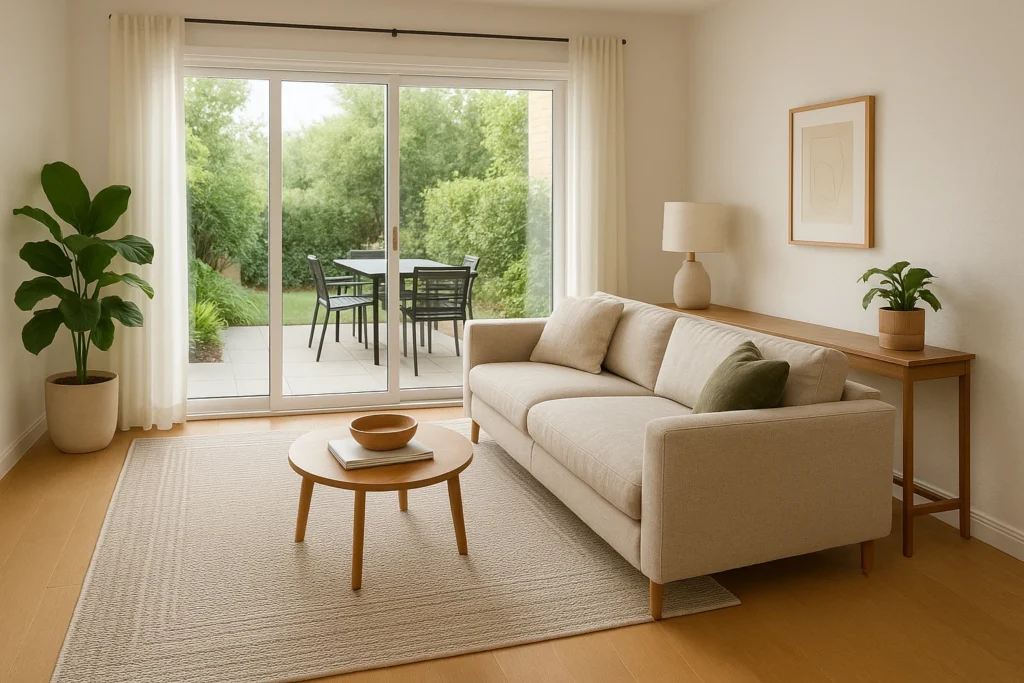
Natural light is magic. A wide expanse of glass brings in far more daylight than a regular window of the same width, softening shadows in corners and making the entire room feel open and breathable. Even small rooms can glow with volume when that extra sunlight flattens visual clutter.
And then there’s “visual annexation.” That’s the design term for how the eye travels beyond the glass and treats the outdoor space as part of the room. When your sight-line doesn’t end at the wall, your brain stretches the dimensions of the space—even if the square footage hasn’t changed one bit.
Door function matters too. In small rooms, a swing door eats into your usable floor space. Sliding, pocket, and bifold patio doors glide instead of opening inward, meaning your furniture can cozy up close without sacrificing access.
Contents
Picking the Right Door Style (and Frame)
| Door Type | Best For | Why It Works in Tight Quarters |
|---|---|---|
| Sliding | Ultra-compact footprints | Panels glide along a track—no swing path to plan around. |
| French Doors | Character-rich interiors | Out-swing styles save interior space; central opening feels wide and charming. |
| Bifold | Modern, wall-to-wall vibe | Panels stack to one side, making the wall virtually disappear. |
Frame matters more than you think. Ultra-slim aluminum or fiberglass frames are trending in 2025 for a reason—they let the glass do the talking while maintaining energy efficiency. Look for thermally broken frames for insulation without bulk.
Layout Tactics: Furniture that Flows
Planning furniture around patio doors is part art, part spatial logic.
Start with the traffic line, not the sofa
Before you drag a single cushion into the room, walk the route you’ll take from the hallway to the patio. That invisible path—ideally 30–36 in wide—should stay clear of furniture corners and lamp cords. Tape it on the floor with painter’s tape; anything that sits inside the tape later is a deal‑breaker.
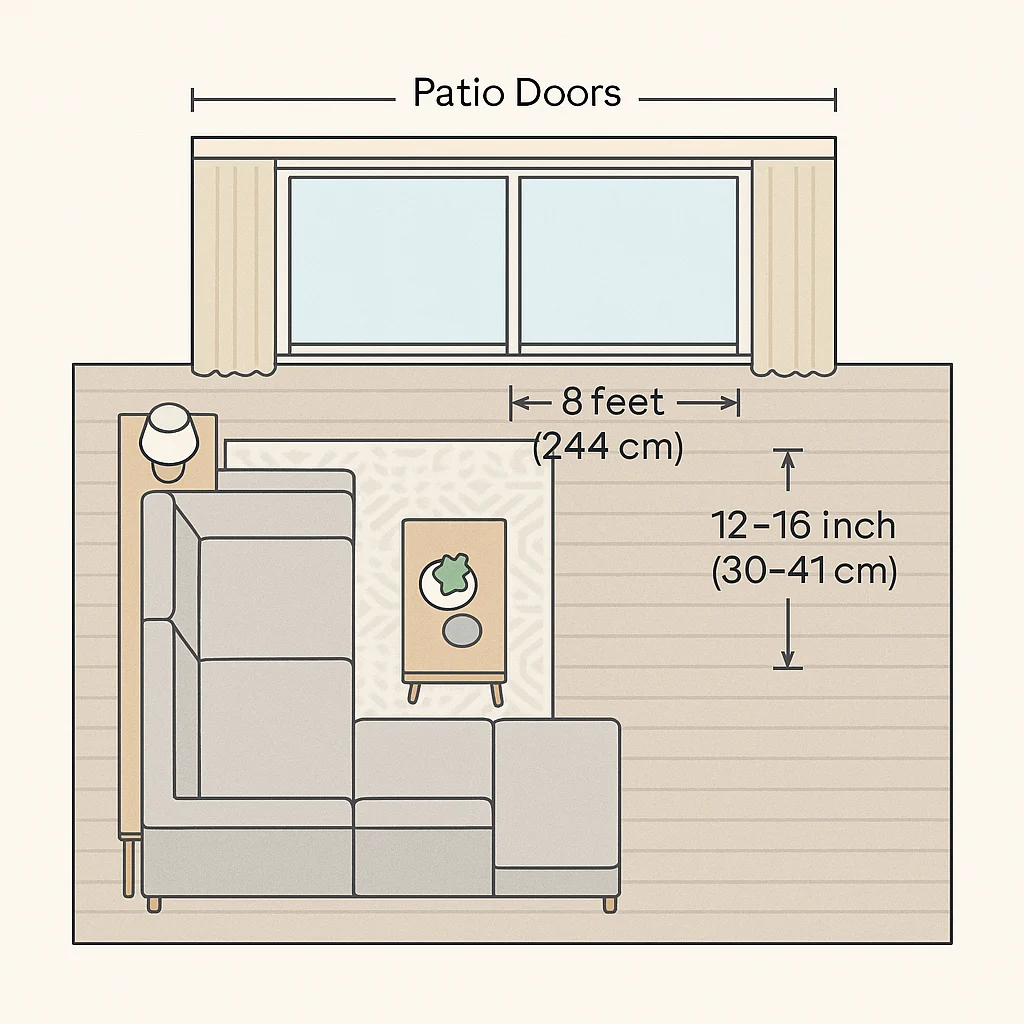
Float the sofa 12–16 in from the glass
A low‑back couch parked about a foot‑plus from the slider does three handy things at once:
- Clearance—you can pull the door open without hip‑checking cushions.
- Depth—the gap creates a pocket of negative space that makes the wall of glass look taller.
- Flexibility—it leaves just enough room for a narrow console table (about 8–10 in deep) to sneak in behind, perfect for a touch lamp, trailing pothos, or that always‑missing TV remote.
Small tweak, big payoff.
Sectional strategy: point the “short leg” at the doors
Corner sectionals feel luxurious but can choke circulation if the L‑shape spans the doorway. Flip it: run the long side parallel to the glass, let the stubby side “hug” the hinge end of the door. That way anyone can slide outside without crab‑walking over ottomans.
Rule of thumb: keep at least one sofa‑length of unobstructed opening, especially for bifolds that concertina to one side.
Let a single rug stitch the zones together
Roll out an indoor–outdoor rug (8 × 10 ft fits most condo‑scale rooms) so it slides a few inches under the sofa front legs and extends right to—or even a hair under—the threshold. The shared textile tricks the eye into reading patio and lounge as one seamless platform.
Small footprints, high function
- Slender side tables (15 in diam.) tuck between sofa arms and door frame for coffee mugs without eating floor space.
- Storage ottomans moonlight as extra seating when the barbecue crowd spills inside.
- Swivel accent chairs parked opposite the glass pivot between conversation and view—no heavy pushing required.
Quick test before you commit
Stand in the room after sundown, lights low. Can you glide from sofa to patio in three steps without stubbing a toe? Good. Now try the same loop balancing a laundry basket or a tray of drinks. If you can pull that off, you’ve nailed the flow.
Dress the Glass: Light, Privacy, and Heat Control
Think of curtains not as coverings but as enhancers—like contact lenses for your windows. The goal isn’t to hide the view, but to refine how it enters the room. Here’s how to strike that balance:
- Go ceiling-mounted. Install curtain tracks at ceiling height to draw the eye upward and keep the window’s vertical line clean and uninterrupted. It’s a subtle trick that makes walls feel taller and the space feel lighter.
- Layer sheer panels for daytime. Light, gauzy fabrics diffuse harsh glare while adding softness to the room’s architecture. They blur the outside just enough for privacy, without cutting out the sun.
- Add blackout or honeycomb shades behind. For movie nights or lazy weekend sleep-ins, a hidden back layer offers darkness and insulation. Bonus: cellular shades bump up your room’s thermal efficiency without bulking up the design.
🚫 Skip the ornate valances and heavy pleats. Anything fussy will crowd the vertical space and draw attention for the wrong reasons. If you want pattern, think big—large-scale prints in calm, muted tones are your friend. Small prints can feel like visual noise in a compact room.
Extend the Material Palette Outdoors
Want to make your room feel twice as large without actually expanding it? Blur the lines.
Use matching flooring materials (or near-matching) between your living room and patio—like continuing hardwood tones outside with composite decking or ceramic planks. Align the pattern direction and grout lines, too; your eye will glide from room to yard without pause.
Bonus move: Repeat a key color—like the teal from your indoor throw pillows—on outdoor cushions or flowerpots. This ties the two spaces together in a subtle but satisfying way.
Harness Cross‑Breezes & Thermal Smarts
Light is only half the story—airflow and comfort are the unsung heroes of a well-performing small living room with patio doors. With a few smart moves, you can make your space feel fresher, cooler, and more energy-efficient year-round.
Catch the breeze—don’t chase it.
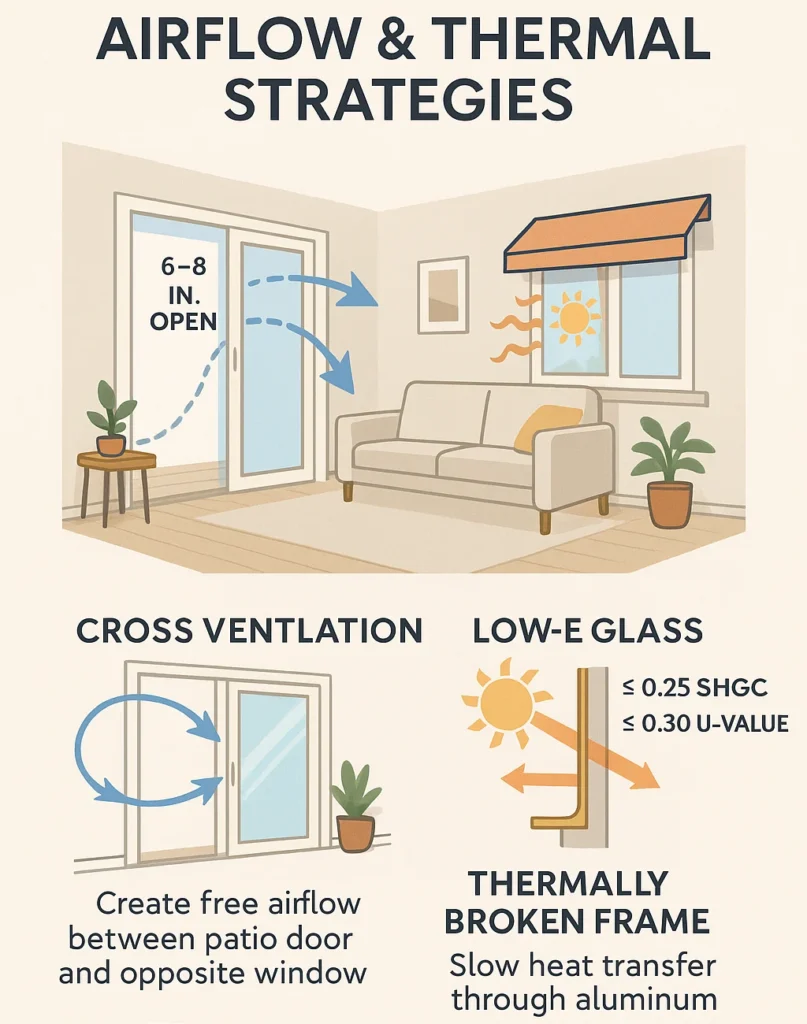
Open your patio doors just 6–8 inches and pair them with a hopper, awning, or casement window on the opposite wall—or at least around the corner in an adjacent space. Here’s the science: warm air rises and exits through the upper part of the open window, creating a low-pressure zone. Cooler outdoor air naturally rushes in through the lower patio door gap to balance it out.
💡 Rule of thumb: The exit window should be at least 60% the size of the patio door opening to feel a noticeable draft.
This gives you a free, whisper-quiet cross-breeze—no fans or filters required.
Low-E glass: sunglasses for your room
Modern patio doors often come with impressive energy ratings—but the key specs to remember are:
- U-value ≤ 0.30 → lower is better at keeping heat in during winter
- SHGC ≤ 0.25 → lower is better at keeping heat out during summer
Low-emissivity (Low-E) coatings reflect infrared heat back toward its source, while argon gas fills between the glass panes help prevent unwanted heat transfer. The result? Your room stays cooler in July and warmer in January—without overworking your thermostat.
Frame the fix
Aluminum and steel frames may look sleek, but they’re thermal superhighways unless they’re thermally broken(separated inside by a non-conductive polyamide barrier). Without that break, your indoor heat can escape right through the frame.
Prefer vinyl or fiberglass? They naturally insulate better but often have thicker profiles—so balance aesthetics with performance depending on your room’s needs.
Shade first, chill later
Want a real heat-buster? Shade outside, not inside.
- A modest 18-inch overhang or awning above south-facing doors blocks harsh summer rays while still welcoming cozy winter sunlight.
- A pergola, sail shade, or leafy vine canopy on the patio can drop indoor temps by 4–7°F—sometimes enough to skip the AC altogether.
Seasonal Flip-Switch
Here’s how to shift your strategy with the seasons:
- Spring / Fall: Crack both patio doors and opposite windows; run a ceiling fan in reverse on low to circulate air upward and out.
- Summer peak: Keep doors closed during midday heat, pull sheer curtains to filter sun, and rely on Low-E glass to do the heavy lifting. Reopen after dusk for a refreshing cool flush.
- Winter: Let midday sun pour in through bare glass for free passive heat. After sunset, close thermal shades or drapes to lock it in.
Nail these airflow and thermal strategies, and your patio-door wall won’t just be the prettiest spot in the room—it’ll be the most energy-smart upgrade you’ve made.
Storage & Styling Micro‑Hacks
Small rooms are won (or lost) in the edges and corners most people ignore. These bite‑size tricks turn patio‑door wall space—and the slivers around it—into stealth storage and visual polish.
1. Bench‑seat cache under the sill
If you have even 14 inches of depth between the floor and the base of the patio frame, build (or buy) a low storage bench. It’s instant extra seating and a hideaway for throw blankets, board games, or the dog’s toys. Top it with outdoor‑grade cushions so you can drag them outside when company spills onto the patio.
2. “Bridge” the doorway with a floating shelf
Run a 1‑inch‑thick plank or a minimalist metal ledge straight across the header—yes, above the doors. Paint it to match the wall so the eye sees the shelf contents (succulents, paperback spines, tiny picture frames) rather than the shelf itself. The glass now looks like a framed art piece—and you’ve earned a full extra linear metre of storage.
Pro tip: use discreet L‑brackets screwed into wall studs; they vanish once you fill the shelf.
3. Mirror opposite the glass, but go narrow and tall
Instead of a wide statement mirror, choose a 14‑inch‑wide, 5‑foot‑tall panel and lean it vertically. The slender proportion copies the door’s shape, doubling the view while eating almost no floor real estate. Bonus: the reflected daylight creeps deeper into the room, so plants on the far wall actually thrive.
4. Slim towers flanking the frame
Those awkward four‑to‑six‑inch strips on either side of the patio doors? Perfect for custom book‑ledges or IKEA picture‑ledge hacks. Face the shelves inward so the spines create a textured border around the glass—like library meets sunroom.
5. Console‑back baskets
Remember that skinny table behind your floating sofa? Slide a trio of woven cubes underneath. They’re invisible from the front but swallow TV remotes, charging cables, and random kid clutter faster than you can say “unexpected guests.”
6. Ottoman with a secret
Swap a hard coffee table for a storage ottoman on casters. Inside: winter throws, VR headset, or that stack of magazines you swear you’ll read. During gatherings, roll it aside for floor space; during movie night, pop the lid, grab the quilt, and kick back.
Mix‑and‑match a handful of these micro‑hacks and you’ll discover that your “tiny” living room was actually hoarding square inches in plain sight.
Common Missteps (and Easy Fixes)
- Blocking the door with a TV unit. Try wall-mounting the TV on a swivel arm adjacent to the patio to keep the door area clean and functional.
- Letting rugs stop at the door frame. Let your rug run a few inches underneath the threshold for a more natural, uninterrupted feel.
- Skipping insect screens. Magnetic or retractable screens are nearly invisible but essential for enjoying fresh air without the buzzing guests.
Quick-Fire Checklist
✔️ Door style: Sliding for efficiency, French for charm, bifold for full exposure
✔️ Frame: Ultra-slim, thermally broken, high-glass ratio
✔️ Furniture layout: Float sofa 12–16″ from glass, leave open walkways
✔️ Window treatment: Ceiling-mount sheers + blackout or shade layer
✔️ Flooring: Align patio and interior materials and layout
✔️ Airflow: Use opposing windows + Low-E glass for comfort
✔️ Storage: Use benches, overhead shelves, and mirrors to expand space
In summary, your patio doors are more than just a feature—they’re the stage manager of your living room’s light, movement, and mood. Treat them right, and they’ll make your small space feel expansive, connected, and effortlessly inviting. Whether you’re sipping coffee at sunrise or throwing the doors open to welcome guests, you’ll feel the difference every time.